A billionaire spots a homeless girl tutoring his daughter what happens next leaves everyone speechless
A billionaire spots a homeless girl tutoring his daughter what happens next leaves everyone speechless
In the heart of Manhattan, amidst the towering skyline and ceaseless bustle, lived billionaire entrepreneur Richard Halston. A self-made man, he had built his empire from scratch—tech investments, real estate, and a private equity firm that now spanned the globe. With money came insulation. His world was glass walls and private jets. His ten-year-old daughter, Emily, was his only soft spot, raised by nannies and tutors in a penthouse that kisse
It was a chilly Saturday afternoon when Richard decided, on a rare impulse, to walk Emily through Central Park himself. He’d cleared his schedule for the first time in weeks, promising her a “real New York walk.” She was delighted, holding his hand tightly as they strolled past vendors and s
They stopped at a small playground near Bethesda Terrace. Emily ran toward the swings, her laughter echoing off the stone arches.
That’s when Richard noticed her.
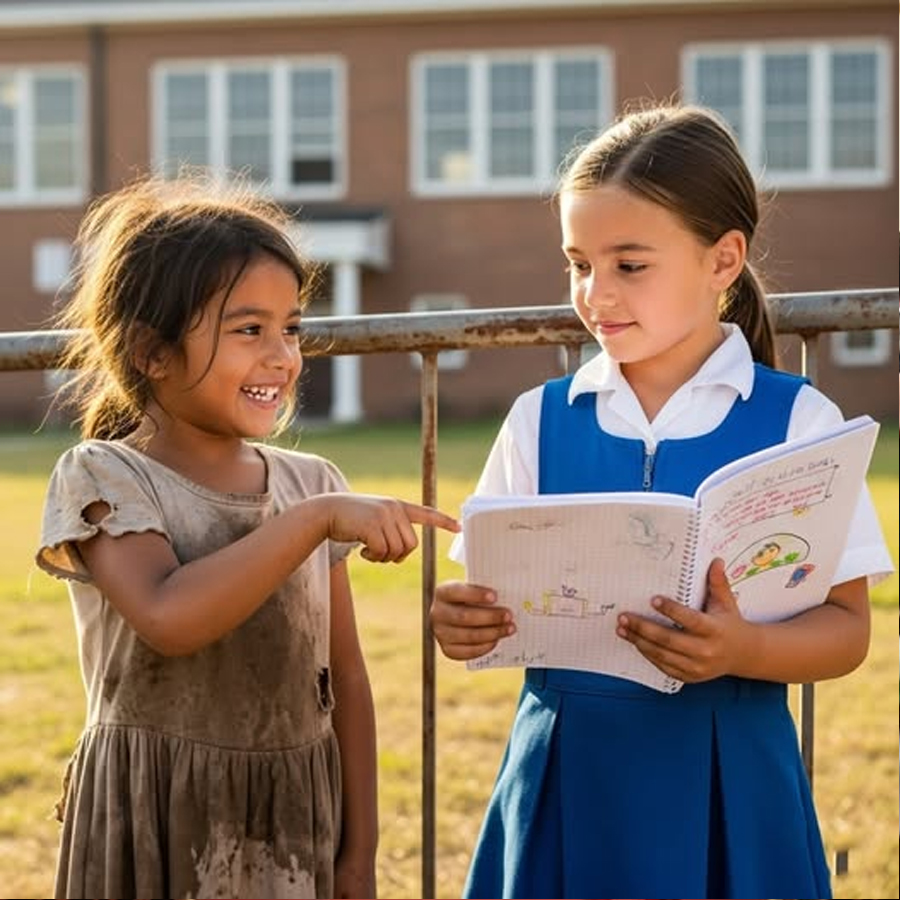
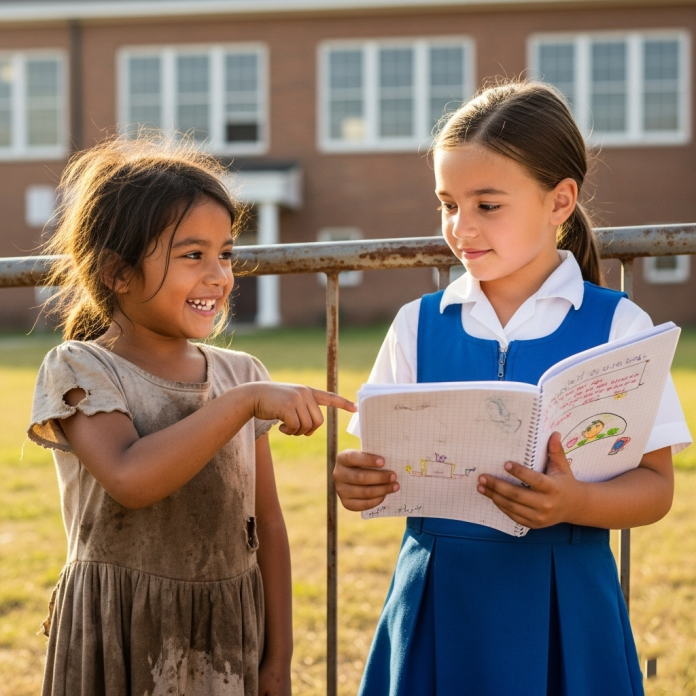
A girl, no older than twelve, dressed in oversized clothes and a worn denim jacket, was sitting on a bench near the sandbox. Her hair was tangled, and her shoes had holes. She was drawing math equations in the dirt with a stick. When Emily wandered too close, the girl looked up cautiously but didn’t move away.
Richard watched in silence.
Emily was kneeling next to the girl now, curious. The two began to talk. The girl—whose name turned out to be Grace—smiled timidly as Emily asked what she was doing.
“I’m solving these for fun,” Grace said, brushing her knuckles against her nose.
“That’s algebra!” Emily exclaimed. “I only just started learning it.”
To Richard’s astonishment, Grace began to teach Emily the concept of solving for x, using twigs and lines in the dirt. Her explanations were clear, patient, and surprisingly advanced. Emily was focused, nodding, her brow furrowed in concentration.
Something in Richard stirred. He walked closer.
“Excuse me,” he said gently. “Where do you go to school?”
Grace looked up, guarded. “I don’t. Not anymore.”
“Why not?”
She hesitated. “My mom lost her job. Then our place. We move around now. Can’t enroll if you don’t have an address.”
There was no anger in her voice—just fact. Richard crouched beside her, trying to piece together what he was seeing.
“You’re very bright,” he said.
Grace shrugged. “I like numbers. They always make sense.”
Emily chimed in. “Dad, she’s better at math than Miss Lacey!”
Richard smiled, but inside, something cracked. He glanced around. There were no adults with Grace. Just a tattered backpack lying under the bench.
That night, the image of Grace haunted him. A homeless girl teaching his daughter—on a park bench, with nothing but dirt and sticks. The irony was brutal.
He didn’t sleep.
The next day, he returned to the park.
Grace wasn’t there.
He came back the day after. And again.
On the fourth day, he spotted her near a food truck, sharing fries with a boy who looked even younger.
He approached carefully. “Grace.”
She froze.
“I’d like to speak with your mother. If that’s okay.”
Grace looked hesitant but eventually nodded. “She’s working near the subway station. Selling scarves.”
He followed her.
What he found stunned him more than anything.
Grace’s mother, Maria, was kneeling on a blanket, weaving handmade scarves. Her eyes were tired but warm. She stood when she saw Richard and instinctively placed a hand on Grace’s shoulder.
“I’m not here to cause trouble,” Richard said. “I watched your daughter teach mine. She’s… brilliant.”
Maria looked confused. “She used to get top marks. Back when… when things were normal.”
“What happened?”
“My husband died. We lost everything. I couldn’t keep our home. The shelters were full. We sleep in a church basement now.”
Richard was silent for a moment. Then he said, “Let me help you.”
Maria tensed. “Why?”
He gestured at Grace. “Because this girl deserves more than the street. And because my daughter needs to learn what real strength looks like.”
Maria stared at Richard Halston, unsure if this was real. She’d learned long ago that promises from men in suits were often empty, or came with strings. But something in his voice—firm yet quiet—told her this was different.
“I don’t want charity,” she said.
Richard nodded. “Neither do I. But talent like Grace’s shouldn’t be wasted. Let me enroll her in a school where she can thrive. A real one. I’ll cover everything—uniforms, books, meals. No publicity. Just a girl getting a shot.”
Grace looked up at her mother, wide-eyed. Maria hesitated, then slowly nodded. “If it’s just for her, then yes.”
Within 48 hours, Richard had pulled strings no average parent could dream of. Grace was tested and admitted into Whitestone Academy, one of Manhattan’s most prestigious private schools, the same one Emily attended. The faculty was stunned by Grace’s raw intellect. She scored in the 99.7th percentile across the board.
But not everyone welcomed her.
Some parents whispered behind their hands. A homeless girl at Whitestone? Was it safe? What did it say about their standards?
Emily heard it all—and shut it down. At recess, she declared loudly, “Grace is the smartest person I’ve ever met. Anyone got a problem with that can talk to me.” That loyalty earned her a bruise from a soccer ball the next day. She didn’t flinch.
Grace didn’t just survive—she soared.
She joined the mathletes, aced science fairs, and once stunned a room full of parents by correcting a visiting Columbia professor during a STEM showcase. She was quickly offered a scholarship extension by the school, no strings attached.
Still, not everything was perfect.
Maria continued working, refusing to live off Richard’s money. She and Grace moved into a modest one-bedroom apartment Richard had arranged through a nonprofit partner, paying subsidized rent with her earnings from scarf sales and, later, a job at a small boutique.
One rainy afternoon, as Richard sat in his corner office overlooking the skyline, his assistant buzzed in.
“There’s a woman named Maria here to see you. Says it’s about Grace.”
He stood immediately.
Maria entered holding a slim envelope. “You’ve done more for us than I could ever repay,” she said. “But I want to try.”
She handed him the envelope. Inside was a handmade card from Grace. On the cover: a sketch of Grace and Emily under the park bench. Inside, written in a 12-year-old’s looping handwriting:
“Thank you for seeing me. When no one else did.”
Below it was a line that made Richard’s throat tighten:
“I want to be someone who helps people the way you helped me.”
That same week, something unexpected happened.
Whitestone held its annual Parent & Philanthropy Gala. Richard, usually allergic to such events, attended this time—with Maria and Grace as his guests.
When the head of school handed Richard the microphone to speak, he did something no one expected.
“I’ve given money to this school for a decade,” he began. “But I’ve learned more in the past three months from a homeless girl in the park than I have from any boardroom.”
Gasps.
He turned to Grace. “This is Grace Mitchell. She taught my daughter how to solve equations with sticks and dirt. She’s also reminded me why education should never be a privilege for the rich—but a right for the capable.”
He looked at the crowd, his voice firm now. “So I’m establishing the Grace Scholarship—fully funded, permanent, and anonymous. For any student like her. Gifted. Overlooked. Determined.”
There was stunned silence. Then—applause.
Years later, Grace graduated valedictorian. Her speech made headlines.
She didn’t talk about poverty or struggle. She talked about the power of being seen.
“Sometimes,” she said, “all it takes is one person believing in you to change your entire life. But you also have to believe in yourself when no one else does. And never stop learning—not even on a park bench.”
She would go on to attend MIT on a full ride. Emily followed her to Boston, majoring in education. The two remained best friends. Sisters, really.
Richard never forgot that moment in Central Park. The dirt, the stick, the swing.
And every time someone called him a genius businessman, he’d smile quietly and think—
“The smartest person I ever met had holes in her shoes.”