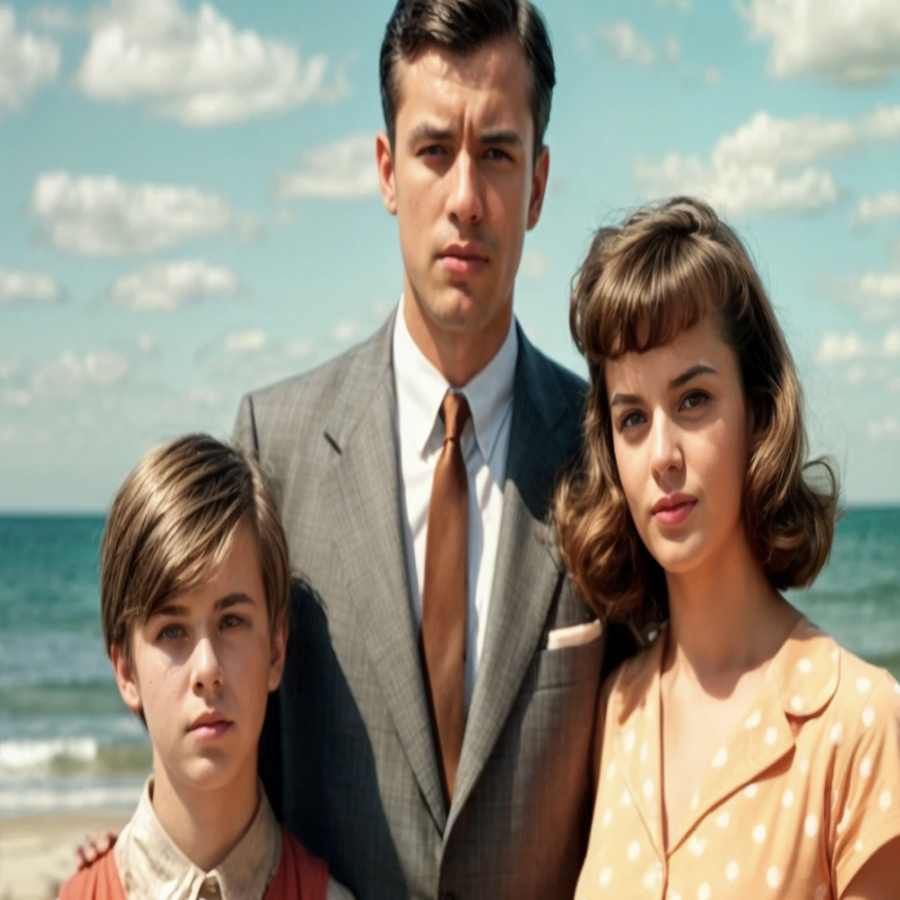
After his wife’s funeral, a father, devastated by grief, took his son to the sea to distract him.

After his wife’s funeral, a father, devastated by grief, took his son to the sea to distract him.
She left — not with a scream, not with a crash, but quietly, like breath on glass, like a whisper through sleep, like the last chord of a beloved melody fading away in an empty room. She left at the very moment when winter, tired of long snowstorms and gray days, began to retreat, yielding its position to spring. The snow, like the tears of time, slowly melted, dripped from the eaves, ran down the windows, leaving wet traces on the facades of houses. Each drop was like a reminder that even the most fragile can turn into a flood, and pain — into a river flowing through hearts. And at that moment, when nature first breathed freely, she left. Forever.
Her name was Alina. That name sounded like a gentle touch of the wind, like the rustle of pages of a favorite book, like the warmth of a fireplace on a cold evening. She was not just a woman — she was light. Not bright, eye-searing light, but soft, golden light, the kind that flows in the morning through translucent curtains, touches the skin, and awakens the soul. Her hair was the color of autumn, when the maple bursts into crimson flames and the sunset melts into the tree crowns. Her laughter was pure, ringing like little bells hanging on the wind in an old garden, like music born of the wind itself. She loved the sea. Not just liked it — adored it. She said it was like the living heart of the planet, beating, breathing, whispering. That in its endless waves were answers to questions people were afraid to ask. “The sea remembers everything,” she said, “and it knows: the pain will pass. Everything will settle. Even death is not the end. Just a turn.”
But the pain did not settle.
It came like an uninvited guest, in a white coat, with a cold stethoscope and papers scribbled with someone else’s words. The diagnosis sounded like a sentence. And she — smiled. Smiled as if it were not death, but an invitation to a last dance.
“Well,” she said, looking into her husband’s eyes, “we have a little less time than we thought. Let’s try not to waste it.”
And she didn’t waste it.
She lived her last months as if every day were a holiday that could not be missed.
She baked pies with apples and cinnamon, filling the house with the scent of childhood. Sang in the shower, laughed at Alexey’s old jokes, which he repeated for the tenth year in a row but each time with new sparkle in his eyes. Read bedtime stories to their son Matvey, inventing endings where dragons became friends and witches became grandmothers. Hugged, kissed, looked into their eyes as if memorizing them forever. And when her strength began to fade, when the pain became too strong to pretend, she simply took their hands — her husband’s and son’s — and whispered, again and again, like a prayer, like a spell, like a last promise:
“I love you. I love you. I love you.”
Those words hung in the air like sacred texts, like a soul’s testament.
And then she was gone.
Silence.
Emptiness.
The world that yesterday had been full of her laughter became alien, heavy like a wet blanket.
The funeral took place in mid-spring.
The sky was gray but not rainy — as if nature itself feared to add tears to those already rolling down faces. People came, spoke warm words, hugged, cried. But Alexey stood as if inside a glass bubble — he saw everything but heard nothing. He held the hand of six-year-old Matvey, who, not understanding what death was, kept asking:
“Dad, when will mom wake up?”
And each time Alexey, with a broken heart, answered:
“Soon, son. Very soon.”
Though he knew — “soon” no longer existed. For him, time stopped the moment her heart ceased to beat.
Two weeks after the funeral, Alina’s mother arrived.
She took the boy into her caring arms and said:
“Take him somewhere. To the sea. To the place she dreamed of. She would want you to live.”
Alexey didn’t want to. Every morning he woke up feeling that inside him was not a heart, but shards of glass, that each breath was like a knife in his chest. He saw no meaning. Felt no future. But for Matvey — for this little person who lost his mother but still believed in miracles — he packed their bags. They went south. To the Black Sea. To the place where Alina had dreamed of spending her last vacation.
“There are beaches there like in a fairy tale,” she said. “And the sea is so warm it feels like it’s hugging you.”
Now he was taking them there — not for happiness, but for a chance.
When they arrived, spring was in full bloom.
The sun shone as if trying to atone for winter. Waves roared, seagulls screamed, children laughed on the beach. Everything was too beautiful. Too alive. Alexey felt like a ghost in a world that went on despite the fact that for him everything had ended. As if the Universe forgot that his heart was broken.
They lived in a small house by the sea.
Every morning Matvey woke with the same hope:
“Dad, will mom come back today?”
And each time Alexey, surrendering but not completely giving up, answered:
“Not today. But she is with us. Always.”
Words he didn’t fully believe, but clung to like a lifeline.
On the third day, they went to the beach.
The sand was warm, the water transparent like glass. Matvey ran along the water’s edge, laughing, building castles that the waves immediately washed away. Alexey sat on a towel, looked into the distance, and thought of her. Of her hands, warm and strong. Of her scent — vanilla and sea. Of how she took off her shoes and ran barefoot on the wet sand, like a child, like a free soul.
And suddenly — a voice.
“Dad… look! Mom’s back!”
Alexey turned cold.
He slowly turned his head.
Along the beach, a hundred meters away, walked a woman. Tall, slender, with long chestnut hair flowing in the wind. She wore a light white dress, sandals held in her hand. She walked barefoot. On the wet sand. Like Alina.
She laughed, looking at the sea.
And her silhouette, outlined by the sunlight, was… frighteningly familiar.
Alexey’s heart stopped.
He jumped up. His legs trembled. He couldn’t move.
He watched as the woman turned her head — and for a moment he thought: it was her.
That a miracle had happened.
That death was a mistake.
That love had won.
“Mom!” shouted Matvey and rushed forward.
“STOP!” Alexey shouted.
He ran after his son, his heart pounding so hard it seemed it would burst from his chest. He caught the boy, grabbed his hand.
“Dad, it’s her! It’s mom!” Matvey cried, trying to break free.
The woman turned around.
She was beautiful.
But — not Alina.
Not at all.
Her face was different. Her voice — foreign.
“Sorry,” she said, smiling. “Maybe I look like someone?”
Alexey couldn’t speak.
He stood holding his trembling son and looked at this stranger who had accidentally become a shadow of his pain, a reflection of his longing.
“No…” he whispered. “Sorry. We… we were mistaken.”
He took Matvey away. The boy cried, clung to his father, whispered:
“But she was so… like mom…”
In the evening, when Matvey fell asleep, Alexey sat on the balcony.
Looked at the sea.
Cried.
Quietly. Silently.
Tears ran down his cheeks, fell on his knees like raindrops.
He remembered her voice. Her touch. Her last look — warm, full of love.
He remembered how she held his hand in the hospital and whispered:
“Don’t hold me if it gets too hard. Let me go. I want you to live.”
And for the first time in all this time, he understood:
She will not return.
Not in this body. Not in a shadow on the sand. Not in dreams.
She left. Forever.
But when he returned to the room, he saw — Matvey was smiling in his sleep.
In his hand, he clenched a small shell they had found during the day.
And on the pillow lay a note, scribbled with crooked letters:
“Mom, I know you are somewhere near. I love you. Don’t go far.”
Alexey knelt by the bed.
Pressed the note to his chest.
Whispered:
“I will let go, Alina. I will try. For him. For us.”
And at that moment, for the first time in a long while, he felt something inside him — not pain, not longing, but love — stir.
As if the wind brought with it a whisper:
“I am with you. Always.”
He went out to the balcony.
Looked at the sea.
At the stars.
At the moon reflecting in the water like a silver path to nowhere.
And whispered:
“Thank you for being.”
And somewhere far away, on the border of sea and sky, he thought he saw a silhouette —
a white dress, chestnut hair, a smile.
But he didn’t run.
He just stood.
Cried.
And loved.
Even through pain.
Even through death.
Because love does not die.
It does not disappear.
It does not rust.
It just changes form.
Becomes wind.
Becomes light.
Becomes a voice in the whisper of waves.
Becomes memory.
Becomes a strength that teaches us to live on.
Becomes the sea that embraces.
Becomes a shell in a child’s hand.
Becomes words on a pillow.
Becomes eternity in a single moment.
And she — is still here.
Advertisements